
How Cold Weather Affects Glycol Dehydration Performance (And What to Do About It)
Every fall, well site operators start thinking about freeze protection: heat tracing, insulation, drained instrument taps. Those steps matter, but there's a quieter risk that doesn't always make the winter checklist: your glycol dehydration system doesn't perform the same way in January as it does in July, and if nobody adjusts for that, you can end up out of spec on water dew point without any single piece of equipment actually "failing."
We talk a lot about winterizing equipment against physical damage. This one is about something a little different: how the glycol dehydration process itself behaves differently as ambient temperatures drop, and what that means for the gas you're putting on the pipeline.
Why Winter Raises the Stakes on Dehydration
Cold gas holds less water vapor at saturation than warm gas does. That sounds like it should make dehydration easier in winter, and in one narrow sense it does. There's simply less water in the stream to begin with. But the margin for error shrinks right along with it. As temperatures drop toward freezing, any water vapor that isn't removed is far more likely to condense out and form hydrates (ice-like solids that can plug valves, instrumentation, and pipeline sections). The Environmental Protection Agency's overview of glycol dehydration notes that inhibiting hydrate formation is especially critical in cold weather, since ice and hydrates can block wellbores, pipelines, and equipment if moisture isn't adequately controlled [1].
In other words, winter doesn't just add a new problem. It removes your cushion on an existing one. A dehydration system that's "close enough" to spec in August can put you in hydrate territory in December.
What Actually Changes Inside the Glycol System
A TEG (triethylene glycol) unit doesn't know what season it is, it just responds to the conditions it's given. A few things shift as ambient temperature drops:
Lean glycol concentration becomes more important. The dryness of your gas leaving the contactor is driven largely by how concentrated (lean) your glycol is when it enters the top tray. Reboiler temperatures in a standard TEG system typically run in the 350–400°F range, staying safely below the roughly 404°F point where TEG begins to thermally degrade [2][3]. That reboiler operating range doesn't change with the weather, but the dewpoint depression you need to hit a given pipeline spec does, because your inlet gas is colder and the contactor is trying to chill water vapor out of it more aggressively. Systems that were producing adequate lean TEG concentration in summer can find themselves under-concentrated relative to what winter conditions demand.
Freezing isn't limited to the gas stream. Glycol circulation and viscosity feel the cold.
As glycol cools, it thickens. That affects how it moves through the circulation pump, the lean-rich exchanger, and the contactor trays or packing. A pump that's sized and calibrated for summer conditions may not deliver the same circulation rate once the glycol itself is colder and heavier, and circulation rate has a direct relationship with how much total water the system can remove, independent of concentration [3].
Cold ambient air can actually work against the regenerator.
This one surprises people. Finned atmospheric condensers on the still column are sensitive to temperature swings, and in cold winter conditions, a low temperature at the top of the column can cause excessive condensation and flood the reboiler [4]. So while cold weather helps in some ways (less water in the gas to begin with), it can hurt regeneration performance in others if the still column and condenser aren't accounted for.
Freezing isn't limited to the gas stream.
Lean glycol lines downstream of the reboiler, surge tanks, and associated piping can freeze during extended shutdowns or cold snaps if they aren't insulated and, in harsher climates, heat-traced. Field discussions among operators in Canada and the northern U.S. describe exactly this failure mode. Glycol solidifying in surge tanks and downstream lines after a shutdown of more than about 12 hours when ambient temperatures drop well below freezing [5]. You can't fix this by adjusting the reboiler; it has to be addressed with insulation and, where conditions warrant it, heat tracing on the piping itself [5].
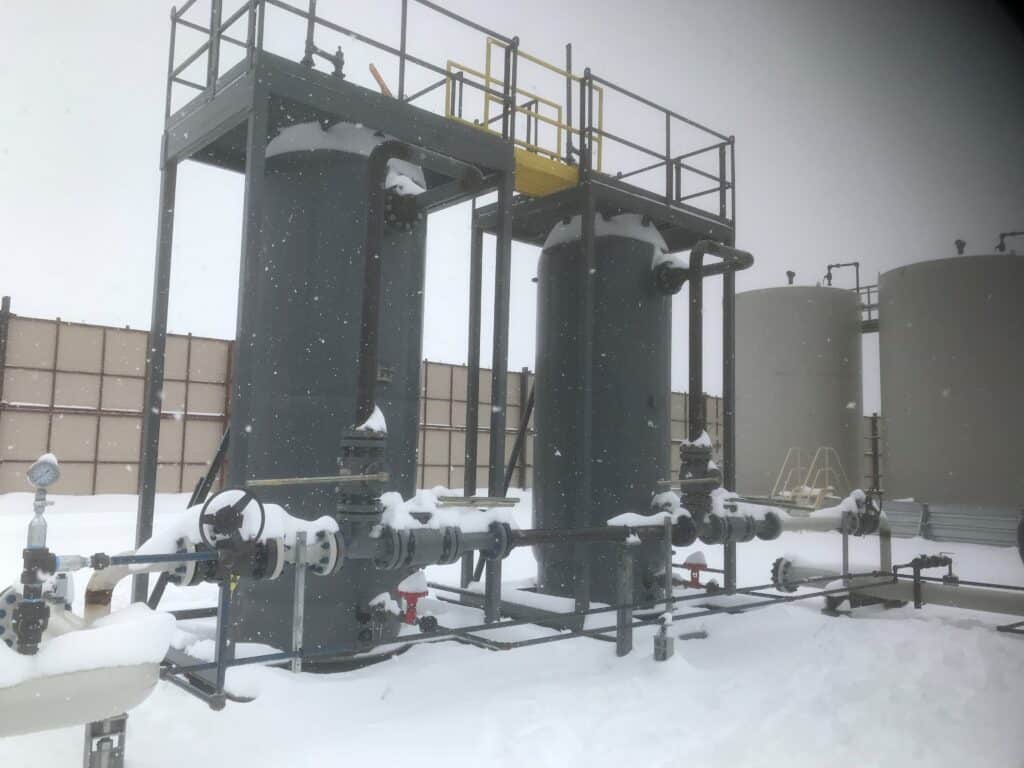
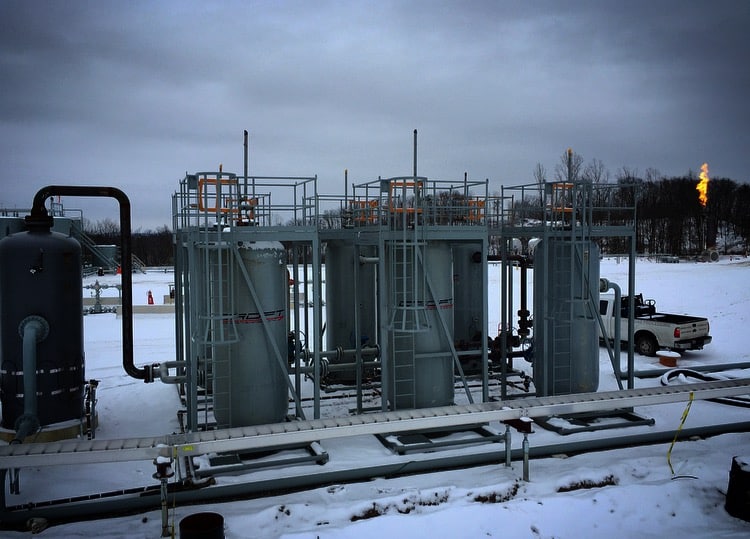
Signs Your System Needs a Second Look Before the Cold Hits
A few things worth watching as temperatures drop:
- Rising water dewpoint on sales gas- even though nothing appears to have physically changed on the unit
- Glycol foaming or visible degradation - often a sign of contamination that gets worse as circulation and heat balance shift
- Pump cycling irregularities - or noticeably reduced circulation rate
- Frost or ice forming on exposed piping, filters, or instrumentation - often the first visible warning sign of a heat tracing or insulation gap
None of these show up as a dramatic equipment failure. They show up as a slow drift out of spec, which is exactly why they're easy to miss until a dewpoint sample or a pipeline nomination gets flagged.
Getting Ahead of It
The fix isn't complicated, but it does need to happen before the first hard freeze, not during it:
- Revisit lean glycol concentration targets for winter operating conditions rather than leaving summer setpoints in place
- Check reboiler temperature and stripping gas rates against current ambient and gas composition data
- Confirm circulation rates are holding up as glycol viscosity increases
- Insulate and, where climate demands it, heat-trace exposed glycol lines, filters, and instrumentation, particularly around surge tanks and reboiler vent lines
- Increase glycol sampling and dewpoint monitoring frequency during cold snaps, rather than relying on quarterly checks
This is exactly the kind of seasonal drift that's easy to catch during a routine service visit and expensive to catch after a freeze-off or an out-of-spec gas rejection. If it's been a while since your TEG system's setpoints were reviewed against current conditions, now, before the first real cold snap, is the time to do it.
Sources
- U.S. EPA, "Glycol Dehydrators," Natural Gas STAR Program
- ScienceDirect Topics, "Glycol Dehydration," overview of TEG dehydration unit operation
- ScienceDirect Topics, "Glycol Loss," reboiler temperature, glycol concentration, and circulation rate relationships
- ScienceDirect Topics, "Glycol Loss," on finned atmospheric condenser sensitivity to cold ambient temperatures
- Cheresources.com Community, "TEG Dehydration Effluent Venting," field discussion of cold-weather glycol freezing in surge tanks and downstream piping